Short answer: In 2026, the easiest-to-use postage meters for small offices are compact, internet-connected models that guide you to the correct USPS® rate, weigh mail accurately, and update rates automatically. Your best pick depends on how much mail you send, how many people use the meter, and whether you need tracking or faster batch processing.
Most businesses want to save time and avoid overpaying on postage, and a postage meter can help with both. A postage meter is a leased device that prints USPS® postage right in your office, either directly on envelopes or on adhesive tape. If you need to check current pricing before choosing a meter, start with this guide.
In 2026, the “easy” meters are the ones that connect to the internet, guide you to the right USPS rate, and update automatically.
Here’s what you’ll get on this page:
- The easiest options by office size and mail volume
- A quick checklist of must-have “easy” features
- A simple comparison table
- FAQs people ask before choosing a meter
Which postage meters are easiest for small offices in 2026?
The best choice usually comes down to how much mail you send and how many people use the machine.
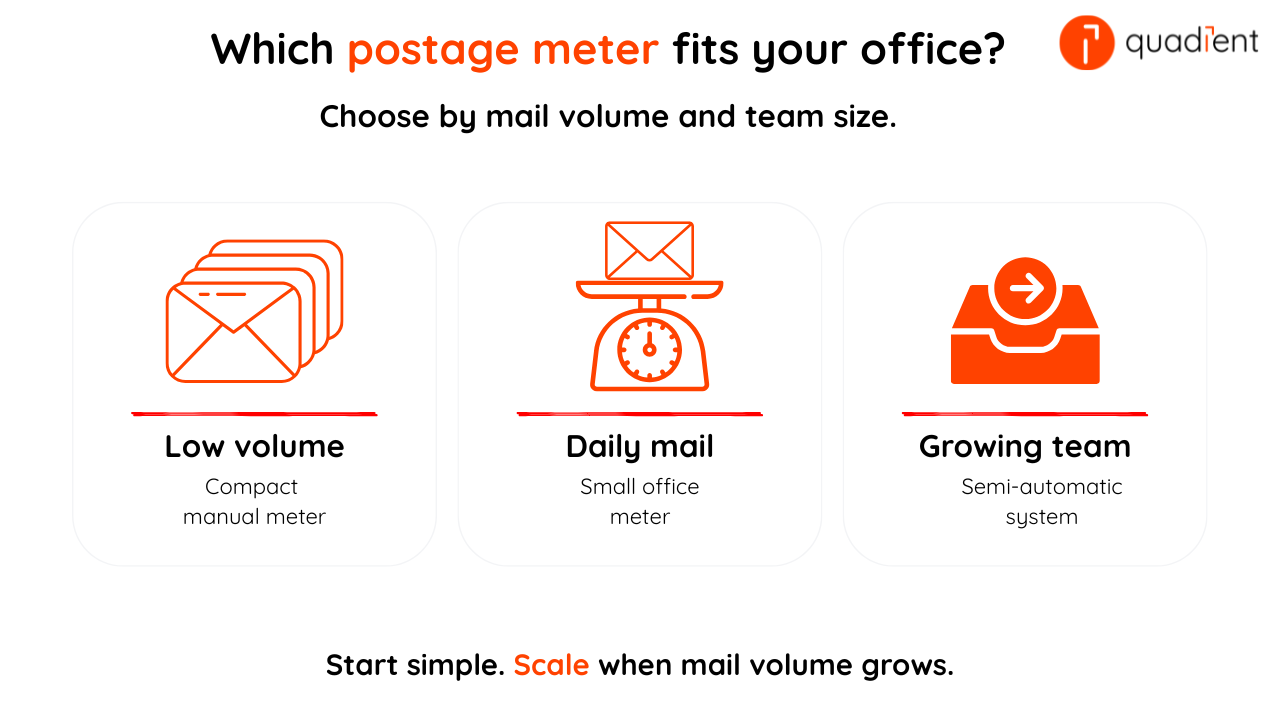
- Best for home offices and low volume (under ~500 letters/month): A compact, manual-feed meter with a built-in scale and guided rate selection (like the Quadient iX-1 Series).
- Best all-around for small offices: A mid-range meter that’s still simple, but faster, with cost tracking and shortcuts (like the Quadient iX-3 Series).
- Best for growing teams: A touchscreen-style mailing system with faster speeds and optional auto-feed for batch work (like the Quadient iX-5 Series).
A quick note on “ease of use”: It’s not just about the screen. The best systems reduce mistakes, keep rates current, and stay compliant with USPS standards like Intelligent Mail Indicia (IMI).
What makes a postage meter easy to use in 2026?
An easy meter lets someone walk up, run mail, and walk away — without training sessions or worry about making mistakes. Look for these features:
- Guided rate selection (so you don’t overpay or underpay)
- Integrated scale for letters and small parcels
- Automatic USPS rate downloads via an internet connection
- Shortcuts for repeat jobs (great for invoices, statements, and daily mail)
- Basic tracking by account/department (so costs don’t disappear into a black hole)
- IMI compliance to avoid issues with older, non-compliant indicia tech
Which postage meter should a small office choose?
Quick product summary:s
- iX-1 Series: best for low volume and tight spaces (simple, occasional use).
- iX-3 Series: best all-around option for steady daily mail (faster + basic tracking).
- iX-5 Series: best for growing teams and batch mail (higher speed + feed options).
Below are three common “small office” situations, with a Goldilocks match for each.
Best for home offices and low volume: Quadient iX-1 Series
If you’re mailing a little each week (and you don’t want a big machine hogging desk space), the iX-1 is built for that. Quadient highlights its compact footprint and detachable 10 lb scale, plus access to many USPS rates/services.
Why it feels easy day-to-day: it’s designed for occasional users — someone can use it once a week and not feel lost.
Learn more: Quadient iX-1 Series
Best all-around for small offices: Quadient iX-3 Series
If your office sends invoices, statements, checks, or customer mail regularly, the iX-3 is a good “middle” choice. It’s still desktop-friendly, but faster, and it adds stronger tracking and shortcut-style controls. The iX-3 processes 45 letters per minute and includes a 5 lb standard weighing platform, plus rate shortcut keys and account/department support.
Learn more: Quadient iX-3 Series
Best for growing teams: Quadient iX-5 Series
When multiple people are running mail, or you’re doing bigger batches, speed and feeding options matter more. The iX-5 Series is positioned as a flexible mid-level system, available in versions that support power-assisted hand feed or auto-feed, and Quadient lists an iX-5 HF speed of up to 75 lpm.
Learn more: Quadient iX-5 Series
Checklist: Will this postage meter be easy for my office?
Run through this quick yes/no test to help make up your mind on a postage meter:
- Can it download USPS rates automatically?
- Does it have an integrated scale that covers what you mail most?
- Can a new staff member run a basic letter without a cheat sheet?
- Are there shortcuts for common jobs?
- Can you track postage spend?
- Is it IMI compliant?
If you answered “no” to more than one question, then it’s probably not the right machine for you.
How do the easiest postage meters compare in 2026?
Match your mail volume and team size to the right category to quickly identify the best fit.
Category | Best for | Processing speed | Feed type | Scale capacity (typical) | Ease-of-use highlights |
Compact manual meter | Organizations with low mail volume and limited daily postage needs | Up to ~20 lpm | Manual | ~10 lb | Guided rates, compact footprint, simple controls |
Mid-range small office meter | Organizations with steady daily mail and basic postage tracking needs | 45 lpm | Manual | 5 lb standard | Shortcut keys, tracking, faster processing |
Semi-automatic / automatic mailing system | Organizations with growing teams and higher-volume batch mailing needs | Up to 75+ lpm | Hand feed or auto-feed | varies by setup | Faster batches, more automation, better shared use |
If you’re unsure, most small businesses start in the compact or mid-range lane, then upgrade only when volume (or staffing) dictates.
What do postage meters cost in 2026, and how do offices save?
Postage meters are leased through authorized providers, and pricing depends on the model and add-ons. Typical costs include:
- Monthly lease
- Ink/labels or supplies
- Postage funding (adding postage to the meter)
- Optional reporting/shipping tools
Savings usually come from the boring-but-real stuff.
- Fewer postage mistakes (less overpay/underpay)
- Fewer Post Office runs
- Less staff time spent weighing, stamping, and fixing errors
- Better visibility into postage spend
For a deeper breakdown of the practical day-to-day benefits, see What are the top benefits of metering your mail in 2026?
Frequently asked questions
What is a postage meter?
A postage meter is a leased device that prints USPS® postage onto envelopes or onto adhesive meter tape from your office.
How much mail justifies a postage meter?
If you send mail consistently—especially a few hundred pieces per month—many offices find the time savings and cost control worth it. (It’s less about a magic number and more about how often you’re doing “stamp runs.”)
Do postage meters update USPS rates automatically?
Modern internet-connected meters download USPS rate changes automatically, which helps keep postage accurate.
Can I mail packages with a postage meter?
Yes, most meters support common USPS services for letters and small packages, depending on your setup and scale capacity.
How do you pick the right easy postage meter for your office?
The easiest postage meter in 2026 is the one your team can use without thinking about it. For low-volume offices, a compact meter like the Quadient iX-1 Series keeps things simple. For steady daily mail, the iX-3 Series adds speed and tracking without becoming complicated. For growing teams and batch work, the iX-5 Series is a strong step up with higher throughput and feed options.
Explore Quadient’s lineup here to compare models side by side: Postage Meters & Mailing Systems.
How much does a postage meter cost for a small office?
Most small-office postage meters are leased through authorized providers, with costs depending on processing speed, included features, reporting tools, and shipping integrations. Typical costs include the monthly lease, supplies like ink or labels, and postage funding.
When does a small office need a postage meter?
A small office usually benefits from a postage meter when staff regularly send invoices, checks, statements, or customer mail and want to reduce trips to the Post Office, avoid postage errors, and simplify day-to-day mailing tasks.