Short answer: Metering your mail in 2026 helps you reduce postage costs, improve mailing workflows, and stay up to date with USPS postage rates and postal regulations, without relying on the post office for every mailing.
Metered mail is not new, but it matters more than ever in 2026. Postage rates continue to change, surcharges are more common, and small businesses are under pressure to do more with less.
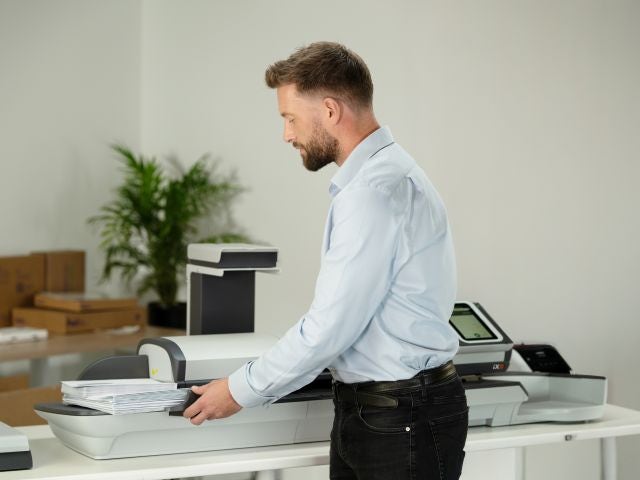
A postage meter helps you print postage directly from your office, mail center, or shared workspace. It reduces trips to the post office, cuts manual labor, and improves tracking and reporting.
What is a postage meter?
A postage meter (also called a postage printer) is office equipment that prints official USPS postage onto envelopes or labels.
Most modern meters are digital meters connected through an internet connection. They automatically download updated USPS postal rates, postage calculation rules, postal regulation changes, and new postage class rules (like First-Class letters vs. domestic packages).
USPS has retired Information-Based Indicia (IBI) postage meters. Businesses must now use IMI-compliant (Intelligent Mail Indicia) systems with digital connectivity, automated rate updates, and stronger reporting tools.
Before looking at the operational benefits, it is worth understanding why physical mail still plays an important role in customer communication.
Why physical mail still matters to customers
Even in a digital world, consumers are more likely to act on important messages delivered by mail than on those delivered by email or other digital channels. According to Quadient research, 63% of US consumers said they are more likely to respond to a time-sensitive communication when it arrives as physical mail rather than a digital message. When mail drives customer action, managing it efficiently becomes a business priority. That is where a postage meter adds measurable value.
Quadient research reinforces this point:
“The research shows that consumers maintain an ongoing trust in physical communications, especially for those that really matter.”
— Alain Fairise, Chief Solutions Officer, Mail at Quadient
If physical mail continues to drive response and trust, the next question is how to manage it efficiently and cost-effectively. Here is how manual mailing compares to metered mail.
Manual mail vs. metered mail: A side-by-side comparison
Feature or benefit | Manual mail (post office) | Metered mail (in-house) |
|---|---|---|
Trips to the post office | Frequent | Minimal |
Postage rate updates | Manual checks required | Automatic downloads |
Cost control visibility | Limited insight | Detailed tracking and reporting |
Accuracy of postage | Higher risk of human error | Digital precision with scale integration |
Workflow efficiency | Manual, time-intensive steps | Streamlined and automated processes |
Here is how those differences translate into practical benefits for your business.
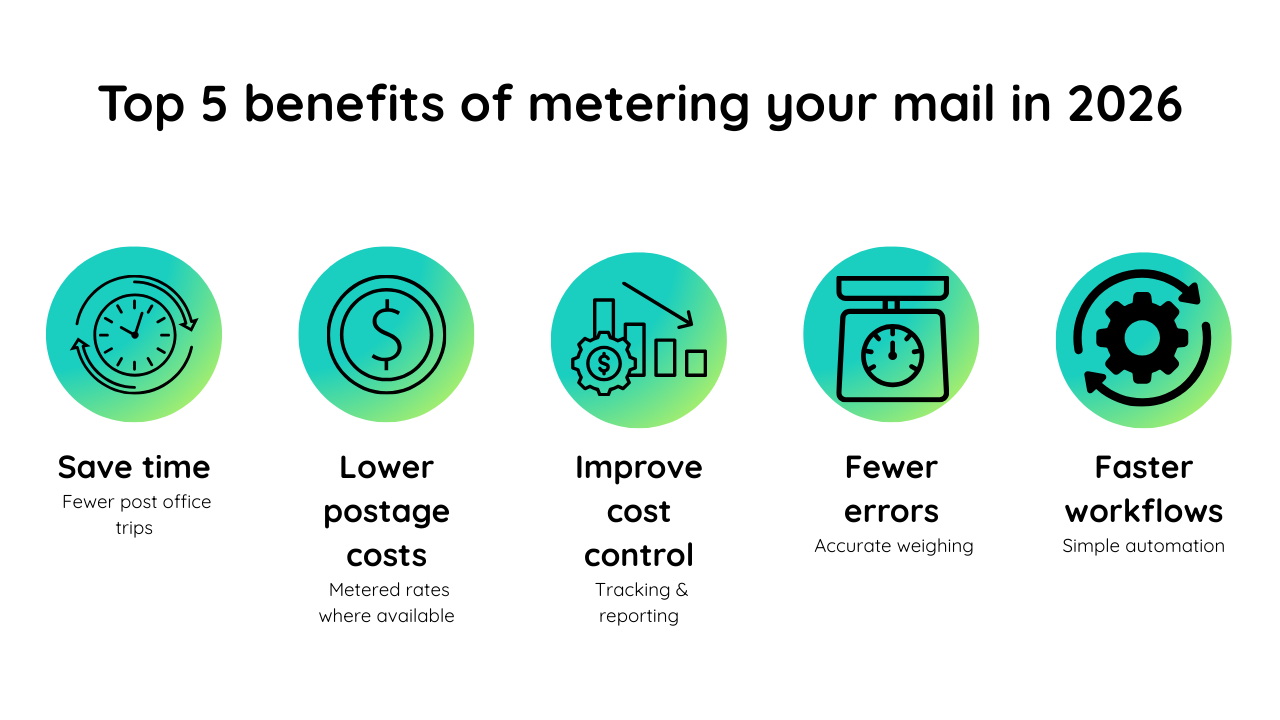
1) Save time and simplify day-to-day mailing
One of the biggest benefits of metered mail is the time it saves.
Instead of waiting in line at the post office, you can print postage in your office and send mail via pickup or drop-off. This is especially helpful if you send customer invoices, domestic letters, First-Class letters, sales materials, or domestic packages.
Reducing trips to the post office also cuts administrative work and frees up staff time for more valuable business tasks.
2) Reduce postage costs and avoid overpaying
USPS only offers metered rates on some mail classes, most notably First-Class Mail letters, where the metered price is often lower than the stamp price.
Even when a special metered rate does not apply, a postage meter still helps reduce postage costs by:
- Printing the correct amount of postage
- Helping users select the right postage class
- Reducing errors that lead to re-mailing
Over time, these small savings add up, especially for businesses with steady mailing volumes.
3) Improve cost control with tracking and reporting
Mail costs often go unnoticed until they become a problem.
A postage meter gives you better visibility into mail spend through tracking and reporting features, such as:
- Postage spend by user or department
- Spend by postage class
- Mailing volume over time
This makes it easier to manage budgets, spot waste, and understand the true cost of physical mail.
4) Reduce errors with accurate weighing and postage calculation
Manual postage calculation often leads to mistakes, such as underpaying, overpaying, or using the wrong postage class.
Most modern mailing systems include a digital scale or connect to weighing scales, making it easier to accurately rate:
- Business-sized letters
- Domestic letters
- Domestic packages
- International shipments
Better accuracy means fewer returned items, fewer surcharges, and less time spent fixing mailing issues.
5) Speed up mailing workflows with automation
As mailing volumes grow, manual steps slow everything down.
Modern digital mailing systems support simple automation that speeds up everyday tasks like:
- Printing postage
- Feeding envelopes
- Printing labels
- Sorting mail by class
This helps small businesses handle higher mailing volumes without adding staff or increasing manual effort.
Who should meter their mail in 2026?
Metering your mail is a strong fit if you:
- Send physical mail weekly or daily
- Mail customer invoices regularly
- Send sales materials or promotional offers
- Handle growing mailing volumes
- Want better tracking and reporting
- Need tighter cost control and cost savings
It is also helpful for small businesses that want to reduce manual effort and trips to the post office.
Final takeaway
Metering your mail is one of the simplest ways to modernize your mailing processes.
A postage meter helps you reduce postage costs, improve mailing workflow, and stay current with postal rates and postal regulations. It also supports better reporting tools, stronger cost control, and more professional-looking mail.
Curious how a postage meter could work for you? Explore Quadient’s postage meters and mailing systems to find solutions that match your mailing volumes.
Frequently Asked Questions
Is metered mail cheaper than going to the post office?
Often, yes. Metered mail can reduce postage costs through metered rates (where available), fewer errors, and more accurate postage calculation.
Do postage meters update USPS postal rates automatically?
Most modern digital meters do. They use an internet connection to download automated rate updates and postal regulation changes.
Can I use a postage meter for bulk mail?
Yes. Many businesses use meters alongside mailing permits and presorted permit mail processes. Bulk mail discounts depend on mailing volume, preparation, and USPS requirements.
What can I mail with a postage meter?
You can send domestic letters, First-Class letters, business-sized letters, domestic packages, and many international shipments, depending on the USPS services available.