Short answer: In 2026, mail automation is all about hybrid delivery, automated workflows, cloud platforms, and control over compliance and costs. The best approach is simple: automate routine communications, keep your data clean (or as clean as possible), use both print and digital channels to cater to your audience's preferences, and make sure every message is accurately delivered, on time, and supports a consistent customer experience.
What is mail automation?
Mail automation is a way to create, prepare, and send business communications like council communications, utility bills, financial statements, or policy notices without manual effort. Instead of printing, folding, and sorting documents by hand, everything is directly handled by automated workflows across physical and digital channels.
Learn more about Quadient’s mail automation solutions.
Why is mail automation important in 2026?
Physical mail still plays a central role for many processes, especially for communications that need to be seen and acted on. When combined with digital channels, it becomes even more effective.
Recent Quadient research highlights why:
- 63% of consumers worry about missing important emails (due to digital fatigue)
- 53% are more likely to act on an urgent letter than an urgent email
For businesses, the opportunity is clear. With mail automation, you can deliver bills, statements, and notices in a way customers are more likely to notice and trust, helping your business meet rising customer expectations and improve customer retention.
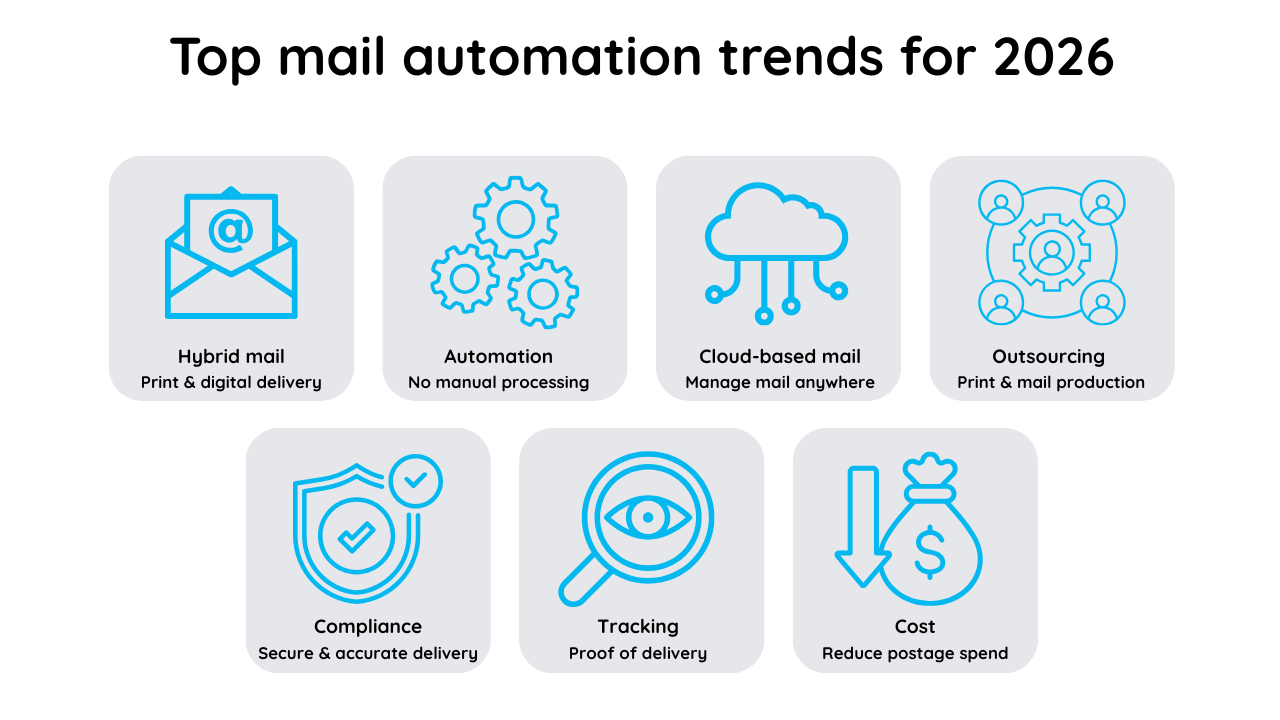
Top 7 mail automation trends for 2026
1. Hybrid mail is the standard
Businesses use both physical and digital delivery. A single platform selects the right channel based on urgency, compliance, and customer preferences, supporting a more consistent customer journey across channels.
2. Manual processes are being automated
Automated systems are able to generate, format, and send communications without any manual effort. They greatly minimise the risk of errors and, more importantly, they save (a lot of) time.
3. Teams can manage and send mail from anywhere
Cloud platforms are helpful when it comes to managing and sending mail from any location. These capabilities are great for distributed teams and help ensure business continuity.
4. Print and mail outsourcing is a standard operating model
Organisations use print and mail outsourcing to shift production to secure facilities, reducing internal workload while maintaining control and visibility.
Explore how Quadient supports print and mail outsourcing.
5. Compliance and accuracy take centre stage
Mail automation ensures the right document reaches the right person. Features like piece-level tracking and audit trails help meet regulatory and compliance requirements and support communications that require proof of delivery.
This is particularly important for organisations operating under UK GDPR and Irish data protection regulations, where accuracy and auditability are essential.
6. Tracking and visibility improve control
Modern systems provide robust reporting and tracking features, helping businesses confirm delivery and monitor performance, especially for bills, financial documents, and legal notices, where delivery confirmation is important.
7. Cost optimisation is a priority
Automation reduces postage costs and undeliverable mail through address validation, presorting, and smarter delivery methods. Franking machines help ensure accurate postage and prevent overpayment, giving organisations more control over mailing costs.
See how Quadient’s postage solutions help reduce mailing costs.
Trends at a glance
Here is a quick overview of the top mail automation trends and their impact:
Trend | What it means | Business impact |
|---|---|---|
Hybrid mail | Combines print and digital delivery | Improves reach and flexibility |
Automation | Eliminates manual mail tasks | Reduces errors and speeds up processing |
Mail from anywhere | Cloud-based mail management | Supports remote teams and business continuity |
Print and mail outsourcing | External production and delivery services | Reduces internal workload and supports secure, compliant mail handling |
Compliance | Audit trails and accuracy checks | Reduces risk and supports regulatory requirements |
Tracking and visibility | Reporting and proof of delivery | Improves reliability and control |
Cost optimisation | Address validation, presort, and franking machines | Reduces costs and waste |
Best practices for mail automation in 2026
- Use multiple channels: Combine print and digital delivery so messages reach customers in the way that works best for them.
- Automate routine communications: Invoices, statements, and notices are ideal candidates.
- Keep data accurate: Clean data and address validation reduce errors and delays.
- Track every communication: Use reporting and proof of delivery, especially for time-sensitive or regulated messages.
- Focus on clarity and timing: Make communications easy to understand and deliver them when they matter most.
Final thoughts
Mail automation gives organisations a more reliable way to manage important communications. By combining physical and digital delivery, businesses can send messages faster, reduce manual work, and make sure nothing gets missed.
Frequently asked questions
What is mail automation?
Mail automation uses software and mailing systems to create and deliver communications automatically across both physical and digital mediums.
What are the benefits of mail automation?
Mail automation reduces manual work, improves accuracy, lowers postage costs, ensures compliance, and helps businesses deliver communications more reliably across print and digital channels, improving customer experience and long-term customer retention.
What is mail automation used for?
Mail automation is used to send invoices, billing reminders, statements, policy updates, and legal notices quickly and accurately across multiple touchpoints.
Why is physical mail still important?
Physical mail is trusted, easy to notice, and effective for important or sensitive communications, especially when combined with digital channels in a broader communication strategy.
What is hybrid mail?
Hybrid mail allows businesses to send communications through both digital and physical channels from one system.
What is print and mail outsourcing?
Print and mail outsourcing is the process of using a third-party provider to print, prepare, and send business communications, reducing internal workload while maintaining control and visibility.
How does mail automation save time?
It removes manual tasks like printing and sorting, speeds up delivery, and reduces errors.
How does mail automation support compliance?
It ensures accurate delivery, provides audit trails, and helps protect sensitive customer data.